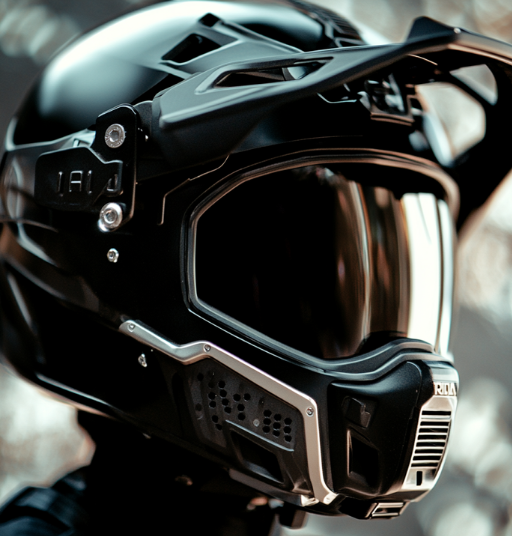
Best Motorcycle Helmet Cameras: Top 5 Ranked

Best Motorcycle Helmet Cam | Top 5 Best Motorbike Helmet Cam

Here are five helmet cameras worth considering, ranked by category so you can match the right camera to how you ride. Rankings use published specifications and the four factors covered in the FAQ below (stabilization, waterproofing, battery life and mount compatibility), not hands-on testing.

Models covered: the cameras named in this guide. Manufacturers release new models regularly, so check current lineups, specifications and prices on the manufacturer pages before buying.

How These Are Ranked

Every camera on this list is evaluated against published manufacturer specifications for the conditions that matter most to motorcycle riders: daily commuting, mountain passes, gravel roads, and track use.

1. Best Overall: GoPro Hero 13 Black

Price: $399 | Resolution: 5.3K60 / 4K120 | Stabilization: HyperSmooth 6.0 | Battery: ~75 min at 4K60

The Hero 13 Black is the best all-round helmet camera for most motorcycle riders. HyperSmooth 6.0 is widely regarded as the most effective electronic stabilization in its class — on rough roads and at highway speeds, the footage is reported to stay smooth without the artificial, over-processed look of some competing systems. The lens mod system (standard, wide, anamorphic) gives it creative flexibility no other action camera matches.

The waterproof to 33ft / 10m rating, impact-tested chassis, and breadth of compatible mounts make it the most versatile camera in this list. For a rider who wants one camera that handles everything from daily commuting to track days to touring, the Hero 13 Black is the recommendation.

Best for: All-round motorcycle use, content creation, track days

2. Best Value: DJI Osmo Action 3

Price: $99-$149 | Resolution: 4K120 | Stabilization: RockSteady 3.0 | Battery: ~90 min at 4K60

At roughly one-third the price of the Hero 13 Black, the Osmo Action 3 delivers approximately 80% of the performance. 4K120 slow motion, dual screens, magnetic mounting, 16m waterproofing, and better cold-weather battery life than any GoPro at any price. It has a strong reputation as a reliable cold-weather camera among motorcycle commuters, per DJI’s published cold-weather battery specifications and user reports.

Full details in our DJI Osmo Action 3 review.

Best for: Budget riders, cold climate commuting, daily use

3. Best for Low Light: Insta360 Ace Pro 2

Price: $349 | Resolution: 4K120 / 8K30 | Stabilization: FlowState | Battery: ~80 min at 4K60

The Ace Pro 2 uses a 1/1.3 inch sensor — the largest in any action camera at this price — and the difference in low-light performance is clearly visible. Early morning commutes through tunnels and dusk riding on shadowed canyon roads all look meaningfully better on the Ace Pro 2 than on the GoPro or DJI. The Leica-tuned lens produces excellent colour accuracy and sharpness.

Best for: Riders who film in variable light, content creators wanting quality footage with minimal editing

4. Best 360 Degree: Insta360 X4

Price: $499 | Resolution: 8K360 | Stabilization: FlowState 360 | Battery: ~81 min at 8K30

The X4 captures everything around you simultaneously. For incident documentation where you do not know which direction a hazard will appear from, and for content creation where you reframe footage in post-production, this changes how you approach filming a ride entirely. The trade-off is that footage requires post-processing before it looks its best, and the stitching seam is visible at certain angles.

Best for: Content creators, riders wanting full-coverage incident documentation

5. Best Always-On Recording: INNOVV H5

Price: ~$250 | Resolution: 4K front / 1080p rear | Recording: Loop recording, auto start/stop | Power: Wired to bike battery

The INNOVV H5 is a fundamentally different product: permanently mounted, wired to the battery, starts recording automatically when you start the bike, and loop-records with front and rear cameras simultaneously. The G-sensor saves a protected clip automatically on impact. For riders whose primary need is accident documentation rather than content creation, it removes all the friction of remembering to charge and mount a camera every ride.

Best for: Commuters, safety-focused riders, anyone who wants always-on protection without daily management

Full Comparison

Camera Price Max Res Best Feature Main Compromise
GoPro Hero 13 Black $399 5.3K60 Lens ecosystem, stabilization Battery life, cold weather
DJI Osmo Action 3 $99-$149 4K120 Value, cold weather battery Older stabilization vs current flagships
Insta360 Ace Pro 2 $349 8K30 Low-light sensor quality Processing-heavy footage
Insta360 X4 $499 8K360 360 degree full coverage Stitching seam, post-processing required
INNOVV H5 ~$250 4K front Always-on, dual channel Not portable, no content creation use

For help choosing based on your riding style and budget, try our AI helmet camera recommender tool.

Frequently Asked Questions

What is the best motorcycle helmet camera?

Among the models compared here, the GoPro Hero 13 Black is the strongest all-round choice on those criteria. For budget riders, the DJI Osmo Action 3 is the best value. For always-on accident protection, the INNOVV H5 is worth considering alongside an action camera.

What should I look for in a motorcycle helmet camera?

Stabilization quality, waterproofing, battery life, and mount compatibility are the four most important factors. See our full buying guide for a detailed breakdown of each.

How do I mount a camera to my motorcycle helmet?

Chin, top, and side mounting are the three main options. Our mount guide covers all three with specific recommendations by riding style.

Reviewed by the Digital Helmet Cameras Editorial Team. Compiled from manufacturer specifications. Prices are approximate and change often; check current listings.

Official resources: GoPro Hero 13 Black | DJI Osmo Action 3 | Insta360 Ace Pro 2.

Best Budget Action Cameras for Motorcycle Riders: Top 5 Under $200

✅ TOP 5 Best Budget Action Cameras 2023

You do not need to spend $400 to get a genuinely capable helmet camera. The budget end of the action camera market has become competitive enough that $150-$200 buys stabilization and image quality that used to require a flagship model. Here are five options at this price point, compared on published specifications. Prices are approximate and change often.

Models covered: the cameras named in this guide. Manufacturers release new models regularly, so check current lineups, specifications and prices on the manufacturer pages before buying.

1. DJI Osmo Action 3 — Best Overall Under $200

Price: $99-$149 | Resolution: 4K120 / 1080p240 | Stabilization: RockSteady 3.0 | Waterproof: 16m without housing

The Osmo Action 3 is a compelling budget action camera for motorcycle riders. At roughly $99-$149 (older stock is often discounted below its launch price), it offers 4K120 slow motion, dual front and rear screens, magnetic mounting, and a 16-metre waterproof rating that is deeper than GoPro’s at this price point.

Cold weather battery performance is its strongest card against GoPro at this price. DJI rates the Osmo Action 3 for reliable operation down to -20°C, and user reports back this up in sub-zero conditions. Battery life at 4K60 is approximately 90 minutes in normal conditions, per DJI’s published specifications. Full details in our DJI Osmo Action 3 review.

2. GoPro Hero (2024) — Best GoPro Under $200

Price: $199 | Resolution: 4K30 / 1080p60 | Stabilization: HyperSmooth 6.0 | Waterproof: 10m without housing

GoPro’s entry-level Hero (2024) at $199 brings HyperSmooth 6.0 — the same stabilization engine as the $399 Hero 13 Black — to a budget body. For motorcycle use where stabilization is the most important technical specification, this is a strong value proposition. The compromises are real: 4K30 maximum, no front screen, and a smaller sensor than the Black models. For a rider who wants clean, stable riding footage at a reasonable price without caring about slow-motion, it is the right GoPro to buy.

3. Insta360 GO 3S — Best Compact Option

Price: $179 | Resolution: 4K30 | Stabilization: FlowState | Weight: 35g camera module

The Insta360 GO 3S is genuinely tiny — 35 grams for the camera module — making it the least intrusive helmet camera you can buy. It uses a magnetic attachment system and sits flush against a helmet surface. Trade-offs: the small sensor means lower image quality than the cameras above in anything other than bright daylight, and the 45-minute battery life limits it for long rides. Best suited for riders who want a camera that is barely there, not for those prioritising raw footage quality.

4. Akaso Brave 8 — Cheapest Capable Option

Price: $80-$100 | Resolution: 4K60 | Stabilization: EIS | Waterproof: 10m with housing

If $150 is still too much, the Akaso Brave 8 at $80-$100 is the best of the very budget options. It shoots 4K60, has basic electronic stabilization, and is waterproof to 10m with the included housing. Important caveat: the stabilization is noticeably inferior to GoPro HyperSmooth or DJI RockSteady. At highway speeds, footage will have more micro-jitter. For slow speed filming or occasional use this is acceptable, but for regular riding documentation the DJI Osmo Action 3 is a meaningfully better tool.

5. GoPro Hero 12 Black (Discounted) — Best Value If On Sale

Price: $200-$280 (watch for sales) | Resolution: 5.3K60 / 4K120 | Stabilization: HyperSmooth 6.0

The Hero 12 Black has been succeeded by newer models, so it is often available at a lower price than at launch. If you can find it at a substantial discount, it is one of the better-value flagship options and is worth comparing with the base Hero (2024).

Which Should You Buy?

For most motorcycle riders at this price point: DJI Osmo Action 3 at $99-$149. The combination of 4K120, dual screen, magnetic mounting, cold weather performance, and 16m waterproofing at that price is genuinely difficult to beat. If you are committed to the GoPro ecosystem or already own GoPro mounts, the Hero (2024) at $199 is the right call.

See our full best helmet camera guide for the complete ranking including premium models above $200.

Frequently Asked Questions

What is the best action camera under $150 for motorcycles?

The DJI Osmo Action 3 at $99-$149. 4K120, magnetic mounting, dual screen, and 16m waterproofing make it the clear choice at this price.

Is it worth spending more than $200 on a helmet camera?

For most riders, no. The jump from $200 to $400 buys higher resolution and better low-light performance — improvements that matter for content creators but are invisible in daily riding documentation footage.

Are cheap action cameras reliable enough for accident documentation?

Yes, if you use a camera from a reputable brand (DJI, GoPro, Insta360). Avoid no-name cameras — their continuous recording reliability is not tested to the same standard.

Reviewed by the Digital Helmet Cameras Editorial Team. Compiled from manufacturer specifications; prices are approximate and change often; check current listings.

Official resources: DJI Osmo Action 3 official page | GoPro Hero 11 Black.

GoPro vs DJI vs Insta360 for Motorcycles: Full Comparison

Which is the BEST Motorcycle Action Camera?  I Tried Them All...

Here is an honest comparison of cameras from all three major action camera brands, based on published specifications and documented performance across commuting, mountain passes, and track use.

Models covered: the cameras named in this guide. Manufacturers release new models regularly, so check current lineups, specifications and prices on the manufacturer pages before buying.

Three Cameras Worth Comparing for Motorcycle Use

  • GoPro Hero 13 Black ($399) — a popular choice as a primary road camera
  • DJI Osmo Action 3 ($99-$149) — rated for reliable cold-weather operation
  • Insta360 Ace Pro 2 ($349) — a strong option for low-light and track use

Video Quality: Who Wins Where

In daylight riding conditions, all three cameras produce excellent footage that most viewers cannot distinguish at normal watching resolution. The differences show up in specific conditions:

Low light (dusk, dawn, tunnels): The Insta360 Ace Pro 2 uses a 1/1.3 inch sensor, larger than the sensors in the GoPro and DJI cameras compared here, which should give it an advantage in dim conditions such as early-morning commutes or tunnels. As a rule, larger sensors produce cleaner low-light footage, but results depend on the settings and lens used.

Colour accuracy: DJI’s colour is generally described as the most neutral, GoPro’s as slightly saturated and punchy (good for social media, less accurate), and Insta360’s automatic processing as the most aggressive.

Dynamic range (bright sky vs dark road): Hero 13 Black with an HLG or Log colour profile is designed to handle the contrast between bright sky and shadowed roads. DJI’s D-Log M is also excellent.

Stabilization on the Bike

All three are excellent. At highway speeds, all three are reported to produce usably smooth footage. On rough gravel roads, GoPro’s HyperSmooth 6.0 is generally considered to handle high-frequency engine vibration marginally better than DJI’s RockSteady, though the difference is small enough that most riders won’t notice it in finished footage.

Cold Weather Performance

This is where the published specifications separate the cameras most. DJI rates the Osmo Action 3 for operation down to about -20°C, while GoPro lists a warmer lower limit (around -10°C) for the Hero 13 Black. Lithium-ion batteries lose capacity in the cold on every camera, so expect shorter runtimes than the figures below, and keep a spare battery in an inner pocket. Check each manufacturer’s spec page for the current operating-temperature rating.

Mounting and Day-to-Day Use

DJI’s magnetic Quick-Release system is the fastest to use on a daily riding basis — one handed, one motion, the camera is off the helmet. GoPro’s standard buckle mount requires two hands and more attention. For daily commuting, DJI’s magnetic system is designed to make getting the camera on and off quick and one-handed.

Battery Life (Approximate)

Figures are approximate, based on manufacturer ratings and published reviews rather than our own measurements. Runtime varies with settings, temperature and battery age.

Camera Approx. Battery at 4K60 Cold-Weather Operating Rating
GoPro Hero 13 Black ~75 min Lower limit around -10°C (GoPro)
DJI Osmo Action 3 ~90 min Rated to about -20°C (DJI)
Insta360 Ace Pro 2 ~80 min See Insta360 spec page

Which Camera Suits Which Rider

Summer road riding and track days: GoPro Hero 13 Black. The lens mod system, stabilization, and established mounting ecosystem make it the most versatile for varied conditions.

Winter commuting: DJI Osmo Action 3. Its cold-weather rating and magnetic mounting make it a strong cold-season choice.

Creative content: Insta360 Ace Pro 2. The 1/1.3 inch sensor is the largest in any action camera at this price and the larger sensor is designed to hold up better in variable light such as shaded roads and late-afternoon sessions, where smaller-sensor cameras can look flat or noisy.

Insta360 markets the Ace Pro 2’s Leica co-engineered lens for sharpness and colour accuracy, which can reduce grading effort. The Insta360 app’s Shot Lab features (auto-cut, AI highlight reels and automatic colour correction) are designed to produce a usable edit from a short ride without desktop editing, which suits riders who publish to YouTube or Instagram without spending hours in Premiere.

The trade-off is that Insta360 footage is more processing-dependent. Recordings in LOG or HLG mode look flat without grading, and the AI edits, while good, do not give you the same manual control as editing GoPro or DJI raw footage yourself. If you want to grade and control every frame, GoPro and DJI give you more flexibility. If you want finished-looking footage faster, Insta360 is ahead.

See our individual reviews for deeper dives: DJI Osmo Action 3 review and our full best helmet cameras guide.

Frequently Asked Questions

Is GoPro or DJI better for motorcycle riding?

GoPro for warm climates and versatility; DJI for cold climates and ease of daily use. Both are excellent — the deciding factors are typically temperature range and mounting preference.

Is Insta360 worth it for motorcycle use?

Yes, particularly the Ace Pro 2 for low-light quality and the X4 for 360-degree coverage. The standard Insta360 action cameras are competitive with GoPro and DJI for most road riding use cases.

Which action camera has the best battery life for long motorcycle rides?

Among these three, the DJI Osmo Action 3 has the longest published battery rating at 4K60 and the widest rated cold-weather operating range.

Reviewed by the Digital Helmet Cameras Editorial Team. Compiled from manufacturer specifications and published stabilization comparisons. Prices and availability change; check current listings.

Official resources: GoPro Hero 13 Black | DJI Osmo Action 4 | Insta360 X4.

Best Helmet Cameras for Extreme Sports: Motocross, MTB and Adventure Riding

Extreme Sports

Extreme sports put camera equipment through conditions that road riding does not: bigger impacts, more dust, heavier mud, more aggressive vibration. Based on published specifications and manufacturer durability claims for motocross, mountain biking and adventure riding, here are models built for these conditions and what makes each suited to its activity.

Models covered: the cameras named in this guide. Manufacturers release new models regularly, so check current lineups, specifications and prices on the manufacturer pages before buying.

What Extreme Sports Demand from a Helmet Camera

  • High-impact crash resistance — cameras will hit the ground at speed
  • Dust and mud ingress resistance — thick dust clouds, deep mud exposure on enduro and trail riding
  • Aggressive vibration tolerance — motocross and enduro vibration patterns are more severe than road riding
  • Weight sensitivity — in MTB and enduro, helmet weight affects ride dynamics and fatigue over long days
  • Mounting security under impact — chin mounts and top mounts need to withstand jumps and drops

Best for Motocross and Enduro: GoPro Hero 13 Black

Price: $399 | Resolution: 5.3K60 / 4K120 | Stabilization: HyperSmooth 6.0

The Hero 13 Black is the top choice for motocross specifically because of Max Lens Mod 2.0 compatibility. The 177-degree ultra-wide lens with horizon lock means even when the bike is bucking over whoops and your helmet is moving aggressively, the footage stays locked to the horizon. The waterproof to 33ft rating handles mud exposure, and the mounting system has a proven track record in off-road use.

For motocross, a chin mount with the adhesive base reinforced with a safety tether — a rubber cord attached to the mount and helmet strap — is a common setup: the tether catches the camera if the adhesive fails during a crash.

Best for Mountain Biking: Insta360 X4

Price: $499 | Resolution: 8K360 | Stabilization: FlowState 360

For MTB, the Insta360 X4 offers something no conventional action camera can: full 360-degree recording. When you are sending a drop or hitting a jump, the camera captures everything — you do not need to frame the shot in advance. In post-editing, you reframe the footage to whatever angle tells the story best: third-person view following the rider, POV from the bars, or a wide establishing shot. The X4 is waterproof to 10 metres without a housing and weighs 203g with battery.

Best for Adventure Riding: DJI Osmo Action 5 Pro

Price: $229 | Resolution: 4K120 / 5.1K60 | Stabilization: RockSteady 4.0

Adventure riding has a specific challenge: long days with variable conditions, including cold mornings and hot afternoons. The Osmo Action 5 Pro handles cold-weather battery performance better than GoPro — maintaining normal function down to -20 degrees Celsius versus GoPro’s -10 degrees. For mountain passes at altitude in October, this is a meaningful real-world advantage. The magnetic Quick-Release mounting system is also excellent for ADV use where you want to quickly remove the camera at a fuel stop or camp.

Best Budget for Extreme Sports: DJI Osmo Action 3

Price: $99-$149 | Resolution: 4K120 | Waterproof: 16m without housing

At under $150, the Osmo Action 3 is a strong-value extreme sports camera. It is waterproof to 16 metres without a housing — deeper than GoPro’s 10m — and the dual front/rear screen is useful for vlogging at rest stops. See our full DJI Osmo Action 3 review for full specifications.

Safety Tether: Essential for Extreme Use

For high-impact activities, always use a safety tether in addition to the primary mount. GoPro and DJI both sell camera tethers, and DIY solutions using a zip tie or paracord through the camera frame work equally well. A safety tether is inexpensive insurance against losing an expensive camera in a crash.

Chin mounting is generally more secure than top mounting for motocross and MTB — it keeps camera weight lower in the helmet and reduces the lever arm that works against the mount during impacts. See our full mount guide for extreme sports mounting specifics.

Frequently Asked Questions

What is the toughest helmet camera for extreme sports?

The GoPro Hero 13 Black has the most proven track record in high-impact use. The housing ecosystem and safety tether options make it one of the most widely used cameras in high-impact conditions.

Can I use an action camera for motocross without a housing?

Yes — all current GoPro, DJI, and Insta360 flagships are waterproof without a housing. For motocross, the risk is less about water ingress and more about physical impact, which modern camera bodies handle well at typical crash speeds.

Is GoPro or DJI better for MTB?

Both are capable for traditional POV footage. For the best creative output in MTB, the Insta360 X4’s 360-degree capture gives you more editing flexibility than either GoPro or DJI action cameras.

Reviewed by the Digital Helmet Cameras Editorial Team. Compiled from manufacturer specifications for motocross, mountain bike, and ADV use cases. Prices and availability change; check current listings.

Official resources: GoPro Hero 13 Black | DJI Osmo Action 4 | Insta360 X4.

Are GoPro Cameras Waterproof? What Motorcycle Riders Need to Know

Go Pro

Getting caught in the rain on a motorcycle is inevitable. Whether your camera can handle it — and to what degree — is something you should know before you need to find out the hard way. Here is the full picture on GoPro waterproofing, what the ratings actually mean, and what to do when the weather turns.

GoPro Waterproof Ratings by Model

Model Waterproof Without Housing Depth Rating
GoPro Hero 13 Black Yes 33 ft / 10m
GoPro Hero 12 Black Yes 33 ft / 10m
GoPro Hero 11 Black Yes 33 ft / 10m
GoPro Hero 11 Black Mini Yes 33 ft / 10m
GoPro Hero (2024) Yes 33 ft / 10m
GoPro Hero 10 Black Yes 33 ft / 10m

Every current GoPro model is waterproof to 33 feet (10 metres) without any housing or case. For motorcycle riding, this means heavy rain, puddle spray, and road wash are fully within the camera’s design specification.

What the 33ft / 10m Rating Actually Means

The 10-metre depth rating is tested under static pressure — a camera sitting in still water at that depth. It is not the same as high-pressure jet exposure. For motorcycle riding, this distinction rarely matters: rain on a moving bike is low-velocity water contact, well within the camera’s capability.

Where riders sometimes run into problems is with damaged seals. The USB-C port door on the Hero 13 Black needs to be firmly closed during rain riding. After significant use, the rubber gasket can wear. GoPro recommends inspecting and replacing the seals periodically if the camera is regularly used in wet conditions.

Riding in Rain: What to Expect

GoPro’s waterproof rating is designed to hold up through sustained rain exposure across the Hero 10 through Hero 13 lineup. A few practical notes:

  • Water on the lens is the bigger problem than water getting into the camera. Rain droplets create smearing and flare. GoPro’s Max Lens Mod 2.0 has a hydrophobic coating that sheds water better than the standard lens. A thin application of Rain-X on the lens between rides also helps significantly.
  • Check the USB-C port door is fully sealed before riding in rain — it is easy to leave slightly ajar after charging.
  • After a wet ride, rinse with fresh water and let the camera dry with the door open before charging. This extends the life of the port seals.

When You Might Need the Protective Housing

GoPro sells a separate Protective Housing that adds additional physical protection. For motorcycle use, this is worth considering if you ride off-road where the camera is exposed to significant mud and debris impact, or if you do motocross or enduro where a crash could send the camera into rocks at speed. For road riding and typical weather, the built-in waterproofing is sufficient without any additional housing.

Alternatives with Equal Waterproofing

The DJI Osmo Action 5 Pro is waterproof to 10 metres without a housing — the same as GoPro. The Insta360 Ace Pro 2 is also waterproof to 10 metres. The DJI Osmo Action 3 has a deeper rating at 16 metres without a housing. See our best motorcycle helmet cameras guide for a full waterproofing comparison.

Frequently Asked Questions

Can I use my GoPro in heavy rain while riding?

Yes. All current GoPro models are waterproof to 33 feet / 10 metres without a housing, well above what any rainstorm will expose the camera to during a ride.

Will rain damage the GoPro microphone?

The microphone ports are protected by the same waterproof seals as the rest of the camera. Water ingress is not a risk during rain, but water near the ports will temporarily affect audio quality until the camera dries out.

Do I need to let a GoPro dry out after riding in rain?

It is good practice. Rinse with fresh water after exposure to mud or road grime, then air dry with the USB port door open before recharging. This extends the life of the port seals over time.

Reviewed by the Digital Helmet Cameras Editorial Team. Compiled from GoPro’s published waterproofing and weather-resistance specifications. Prices and availability change; check current listings.

Official resources: GoPro Hero 13 Black waterproofing specifications | Full GoPro camera range.

Action Camera vs GoPro: Are They the Same Thing?

helmetcamerawatercolor

Short answer: GoPro is a brand of action camera, in the same way that Hoover is a brand of vacuum cleaner. The terms are often used interchangeably — especially among new riders — but there is an important distinction when you are shopping for a motorcycle helmet camera, because some of the best options are not GoPros.

Models covered: the cameras named in this guide. Manufacturers release new models regularly, so check current lineups, specifications and prices on the manufacturer pages before buying.

What Is an Action Camera?

An action camera is a compact, rugged video camera designed to be mounted to helmets, handlebars, and other surfaces during physical activity. Key characteristics:

  • Small form factor — typically under 200g
  • Wide-angle fixed lens
  • Electronic image stabilization
  • Waterproof or water-resistant without a housing
  • Designed for extended continuous recording

GoPro pioneered this category with the original GoPro Hero in 2004. Today, several manufacturers make action cameras that compete directly with GoPro — and in some areas surpass it for specific motorcycle use cases.

Major Action Camera Brands

Brand Key Models Best For Price Range
GoPro Hero 13 Black, Hero 12 Black, Hero (2024) All-round use, large accessory ecosystem $199-$399
DJI Osmo Action 5 Pro, Action 4, Action 3 Cold weather, dual screen, magnetic mounting $99-$299
Insta360 Ace Pro 2, X4, GO 3S 360 degree footage, low-light quality, compact size $179-$499
INNOVV H5, C5, K5 Always-on loop recording, dual channel front and rear $130-$350
Sena 5C, 50C Integrated helmet intercom and camera combination $299-$499

When to Choose a Non-GoPro Action Camera

DJI Osmo Action 5 Pro is worth choosing over GoPro if you ride in cold climates. DJI’s battery maintains normal function down to -20 degrees Celsius versus GoPro’s rated -10 degrees. The magnetic Quick-Release mounting is also faster to attach and detach than GoPro’s standard clips. See our DJI Osmo Action 3 review for a full breakdown of its cold-weather specifications.

Insta360 X4 is the choice if you want 360 degree footage — it captures everything around you simultaneously, useful for incident documentation where you are not sure which direction an event will come from, and for creative content where you reframe the shot in post-production.

INNOVV H5 is a fundamentally different product: permanently mounted to the bike, wired to the battery, starts recording automatically with the ignition, and loop-records with front and rear cameras simultaneously. If your primary use case is accident documentation rather than content creation, the INNOVV is worth evaluating alongside any action camera.

The GoPro Advantage

GoPro’s key advantage is its accessory and mount ecosystem. The standard GoPro mounting system has been consistent across generations, meaning hundreds of compatible mounts exist from both GoPro and third parties. If you already own GoPro mounts, there is a real practical benefit to staying in the ecosystem.

For a full breakdown of how these cameras compare in real motorcycle conditions, see our best helmet cameras guide.

Frequently Asked Questions

Is GoPro the best action camera for motorcycles?

GoPro is the best-rounded choice for most riders, but DJI and Insta360 match or beat it in specific areas. The right choice depends on your priorities: cold weather performance, 360 degree capability, dual-channel recording, or content creation workflow.

Are GoPro mounts compatible with other action cameras?

Some action cameras include GoPro-compatible mounting adapters (DJI and some INNOVV models). Others use proprietary mounting systems. Always check compatibility before assuming your existing GoPro mounts will work with a new camera.

What is the difference between an action camera and a motorcycle dashcam?

Action cameras (GoPro, DJI, Insta360) are manually operated and battery-powered. Motorcycle dashcams (INNOVV, Viofo) are permanently wired to the bike, start and stop automatically with the ignition, and loop-record. Many riders use both.

Reviewed by the Digital Helmet Cameras Editorial Team. Compiled from manufacturer specifications for GoPro, DJI, Insta360, and INNOVV. Prices and availability change; check current listings.

Official resources: GoPro official camera range | DJI action cameras | Insta360 action cameras.

GoPro vs iPhone for Motorcycle Filming: Which Camera Actually Wins?

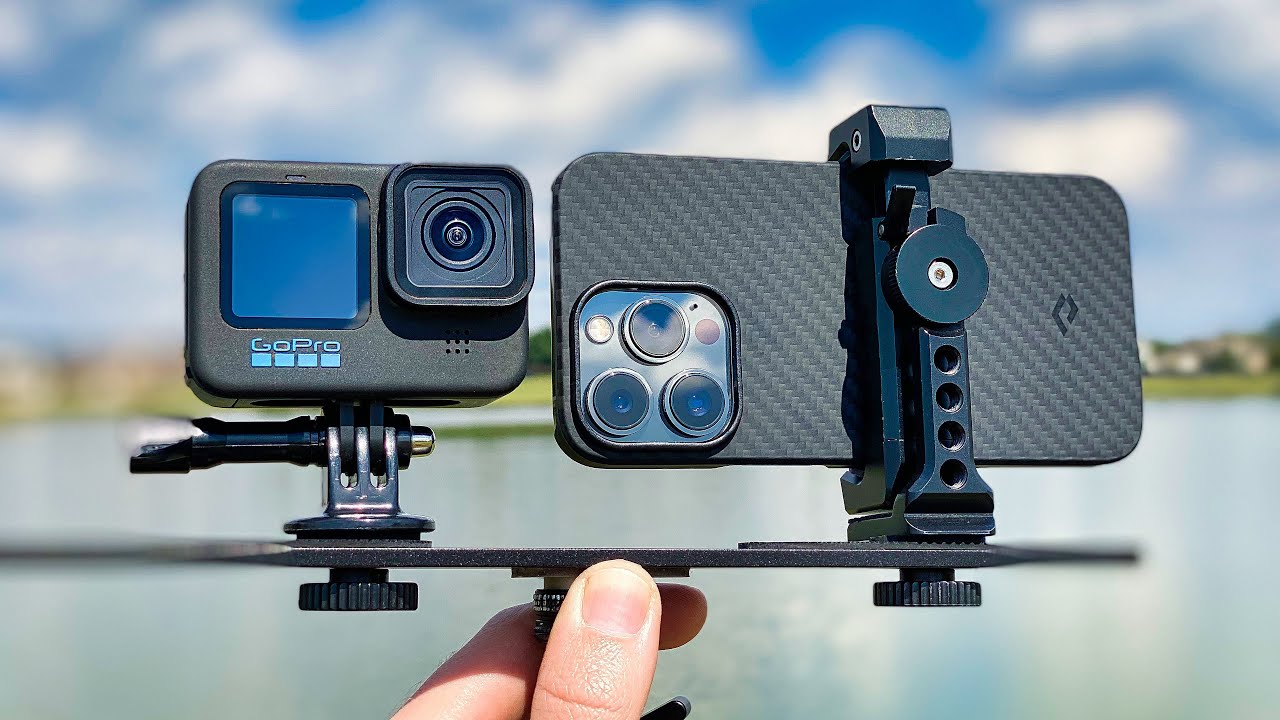
GoPro HERO 10 vs iPhone 13 Pro!

The honest answer depends entirely on what you are trying to do. For helmet mounting during a ride, the GoPro wins clearly. For everything else, the gap is much smaller than GoPro’s marketing suggests. Here’s how the two compare in real motorcycle conditions.

The Case for Using Your iPhone

Modern flagship phones shoot genuinely impressive video. The iPhone 15 Pro shoots 4K120 with Apple’s Log video format. In good lighting conditions, computational photography in a modern phone frequently beats a GoPro on pure image quality metrics. For filming your bike at a photo stop or a short talking-head piece to camera, your phone is an excellent tool you already have with you.

The Case Against Your iPhone on a Motorcycle

Vibration damage

Apple issued a support document in 2022 specifically warning against mounting iPhones to motorcycle handlebars due to engine vibration causing optical image stabilization and autofocus damage. The same risk applies to helmet mounting. GoPro cameras are built for this environment — iPhones are not.

Size and weight

A modern iPhone is approximately 160mm x 78mm x 8mm and weighs around 240g — heavier than a GoPro Hero 13 Black at 154g. On a chin or top mount, that extra weight and larger surface area create aerodynamic drag and affect helmet balance at speed.

Heat and battery

iPhones throttle performance when hot. A phone recording video in direct sunlight during a summer ride while also running navigation will frequently hit thermal limits and stop recording. GoPros are designed to record continuously in outdoor conditions.

Dedicated recording vs multitasking

Using your phone as a helmet camera means it is unavailable for navigation, music, and communication for the entire ride. A separate GoPro leaves your phone free for everything else.

Side-by-Side Comparison

Test GoPro Hero 13 Black iPhone 15 Pro
Stabilization at 70mph helmet mount Excellent — HyperSmooth 6.0 Good but not designed for this
Wind noise at motorway speeds Poor (both cameras suffer equally) Poor
Image quality in bright sunlight Very good Excellent
Image quality at dusk Good Better (larger sensor, Night mode)
Battery continuous recording ~75 min (replaceable) ~90 min (heats up, non-replaceable)
Waterproofing in rain 33 ft / 10m — no housing needed IP68 — fine in light rain
Helmet mountability Excellent — designed for it Poor — too large, no purpose-built mount
Vibration resistance Built for it Risk of hardware damage (Apple advisory)

The Verdict

For helmet-mounted riding footage: GoPro wins on practicality, safety, and purpose-fit design. For filming your bike parked or during breaks: your iPhone is perfectly fine and already in your pocket. The two tools complement each other rather than compete.

For the best GoPro to pair with your iPhone workflow, see our GoPro for motorcycle riders guide, or our full best helmet cameras guide to compare GoPro against DJI and Insta360.

Frequently Asked Questions

Can I mount my iPhone to my motorcycle helmet?

Technically yes, but it is not recommended. The size and weight create aerodynamic drag, the vibration creates hardware risk, and using your phone for recording means no navigation for the ride.

Is GoPro video quality better than iPhone?

In most controlled conditions, no — modern iPhones have excellent cameras. In motorcycle-specific conditions (vibration, airflow, continuous recording), GoPro is the more reliable and purpose-appropriate tool.

What does Apple say about motorcycle vibration and iPhones?

Apple published a support document warning that high-amplitude vibrations from high-power motorcycle engines can damage the iPhone camera system. They recommend against mounting iPhones directly to motorcycle handlebars or high-vibration surfaces.

Reviewed by the Digital Helmet Cameras Editorial Team. Comparison based on published GoPro and iPhone camera specifications. Prices and availability change; check current listings.

Official resources: GoPro Hero 13 Black specifications | iPhone 16 Pro camera specifications.

GoPro Disadvantages for Motorcycle Riders: An Honest Assessment

GoPro HERO 10 Worth It? (The Good, The Bad, The Ugly)

GoPro makes genuinely excellent cameras. But if you read only the manufacturer marketing, you will miss real-world limitations that affect motorcycle riders specifically. Here is the honest list — what GoPros do not do well, and what alternatives exist for each issue.

Models covered: the cameras named in this guide. Manufacturers release new models regularly, so check current lineups, specifications and prices on the manufacturer pages before buying.

1. Wind Noise Is a Significant Problem

The single biggest complaint from motorcycle riders who buy their first GoPro is the audio. At speeds above 40mph, wind noise dominates the recording almost completely. The Hero 13 Black has a built-in wind noise reduction mode, and it helps — but it does not solve the problem. At motorway speeds you will hear a constant roar.

The fix: A foam windscreen over the microphone ports costs $5-$10 and makes a meaningful difference. Some riders run an external Bluetooth microphone inside the helmet near their mouth, which bypasses the wind issue entirely.

2. Battery Life Is Limited for Long Rides

The GoPro Hero 13 Black gets approximately 70-80 minutes of recording at 4K60 before the battery is depleted. For a day ride, that is not enough without a plan. The camera accepts USB-C charging while recording, so you can run power from your bike’s USB outlet — but this requires a cable routed through your gear. In cold weather below 5 degrees Celsius, battery capacity drops noticeably.

The fix: GoPro Enduro battery (adds around 50% life), a spare battery with dual charger, or USB-C power wired from your bike.

3. Overheating During Extended Recording

GoPros have a reputation for overheating, particularly at maximum settings (5.3K60) for extended periods. When the camera overheats it shuts down recording — exactly what you do not want when something happens on the road. Airflow from riding acts as passive cooling, so it is less common than in stationary use, but remains a risk at track days or slow technical riding in summer heat.

The fix: Keep the camera out of direct static sunlight when not riding. For track days in summer, consider the DJI Osmo Action 5 Pro, which has better thermal management.

4. The Wide-Angle Lens Distorts Footage

GoPro’s ultra-wide lens (up to 155 degrees) creates barrel distortion — the fish-eye look that makes straight roads appear curved. GoPro’s horizon leveling and linear lens mode reduce this significantly, but you lose some field of view in the process.

The fix: Use linear or narrow lens mode in GoPro settings. This eliminates most distortion but narrows the field of view to roughly that of a standard wide-angle camera.

5. Accessories and Subscriptions Add Up

The camera body is not the full cost. Mounts, cases, batteries, media mods — GoPro’s accessory ecosystem is expensive and largely proprietary. GoPro also pushes a $49.99/year subscription for cloud backup, which is optional but aggressively marketed.

The fix: Third-party mounts compatible with GoPro’s standard mounting fingers are widely available and significantly cheaper. The subscription is unnecessary for most motorcycle riders — local storage on a fast microSD card is sufficient.

6. No Zoom and No Rear-Facing Camera

GoPro uses a fixed wide-angle lens with only a low-quality digital zoom. And it records only what is in front of it — for accident documentation, many riders want rear-facing recording as well.

The fix for rear coverage: The INNOVV H5 is a dual-channel system (front and rear) purpose-built for motorcycles with continuous loop recording. It is a fundamentally different product from a GoPro but solves the rear coverage problem. See our best motorcycle helmet cameras guide for the full comparison.

Are These Dealbreakers?

For most riders, no. Wind noise and battery life are the most practically significant issues, and both have workable solutions. GoPro remains the best-supported, most capable action camera for motorcycle helmet mounting among mainstream options. But if rear coverage is critical for your use case, there are alternatives worth evaluating before you commit.

See our full helmet camera buying guide for how GoPro stacks up against DJI, Insta360, and purpose-built motorcycle cameras.

Frequently Asked Questions

What is the biggest disadvantage of GoPro for motorcycle use?

Wind noise in the audio. At highway speeds, the built-in microphone records mostly wind regardless of noise reduction setting. A foam windscreen helps significantly but does not fully eliminate the problem.

Does GoPro overheat on a motorcycle helmet?

Less commonly than in stationary setups, because riding creates airflow around the camera. On slow technical riding or in extreme summer heat, it remains a risk at maximum resolution settings.

Is GoPro worth buying despite these disadvantages?

Yes for most riders. The stabilization, build quality, and mount ecosystem are industry-leading. The disadvantages are real but manageable with the right accessories.

Reviewed by the Digital Helmet Cameras Editorial Team. Compiled from GoPro’s published specifications and documented user reports. Prices and availability change; check current listings.

Official resources: GoPro official camera range | DJI Osmo Action 3 – alternative option.

GoPro vs Regular Camera for Motorcycle Riding: What Is Actually Different?

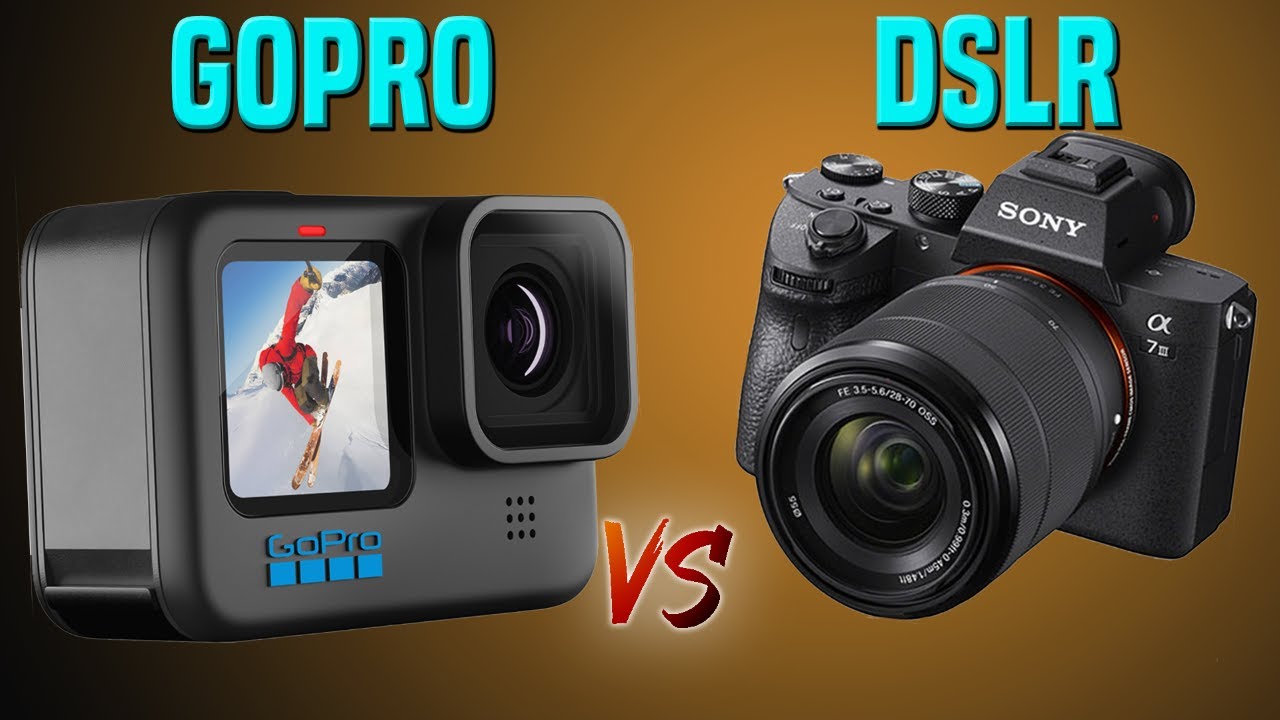
*New* GoPro Hero 10 Black Action Camera VS. DSLR Cameras! - Will GoPros Replace DSLRs?

One of the most common questions from new riders shopping for a camera is why they need an action camera at all — they already have a phone with a great camera, or a DSLR at home. Here is the honest answer to what makes a GoPro different, and why it matters specifically for mounting to a motorcycle helmet.

What Makes an Action Camera Different

A GoPro and action cameras in general are designed around constraints that regular cameras are not built for:

  • Compact, mountable form factor — small enough to attach to a helmet without affecting aerodynamics or balance
  • Wide-angle fixed lens — captures your full riding environment without needing to aim
  • Electronic image stabilization — compensates for vibration from the road and engine
  • Rugged and waterproof construction — survives rain, dust, mud, and impact without a housing
  • Continuous recording — designed to run for extended periods, not just short bursts

Side-by-Side: GoPro vs DSLR for Motorcycle Use

Feature GoPro Hero 13 Black Typical DSLR / Mirrorless
Weight 154g 500-900g body only
Helmet mountable Yes — standard mount system No
Waterproof Yes, to 33 ft / 10m Weather-sealed at best
Stabilization on vibrating bike HyperSmooth 6.0 — excellent IBIS only — inadequate for handlebar vibration
Wide-angle coverage 155 degree ultra-wide Depends on lens fitted
Price (entry) $199 $600+
Low-light quality Good on Hero 13 Better (larger sensor)

GoPro vs Smartphone for Motorcycle Recording

The phone camera question is more nuanced. Modern iPhones and flagship Android phones shoot excellent video — often better than a GoPro in good light. The practical problems are:

  • Mounting — phones are large and heavy. A phone on a helmet mount shifts your centre of gravity and creates wind drag at speed.
  • Vibration — handlebar-mounted phones are notorious for destroying gyroscope sensors due to engine vibration. Apple has issued specific warnings about this.
  • Heat and battery — phones overheat during extended recording in direct sunlight, especially when also running GPS navigation.
  • Screen availability — leaving your phone recording ties up your navigation and communication tools for the entire ride.

For a dedicated helmet camera that runs for an entire ride, a GoPro or action camera is the right tool. For occasional filming at a photo stop, your phone is perfectly fine.

When a Regular Camera Is the Right Choice

If you are filming motorcycle content for YouTube — beauty shots of your bike, scenic overlooks, talking-head content — a mirrorless camera with a quality lens produces better image quality than any action camera. GoPro is the right tool for footage captured while in motion. A mirrorless is the right tool for everything filmed off the bike.

Many motorcycle content creators use both: a GoPro on the helmet for POV riding footage, and a mirrorless for scripted segments and b-roll. See our helmet camera buying guide for a full breakdown of on-bike camera selection.

Frequently Asked Questions

Can I use a regular action camera instead of a GoPro?

Yes — GoPro is just the most well-known brand. DJI, Insta360, and INNOVV all make excellent action cameras for motorcycle use. See our DJI vs GoPro comparison for specifics.

Is a GoPro better than an iPhone for mounting to a motorcycle helmet?

Yes, for helmet mounting specifically. The size, weight, dedicated mount system, and purpose-built stabilization make a GoPro significantly more practical than a phone on a helmet.

What is the main disadvantage of a GoPro over a regular camera?

Image quality in low light and at distance. The small sensor and fixed wide-angle lens mean GoPros are not suited for filming distant subjects or shooting in dark conditions. For on-road riding footage in normal daylight, this is rarely an issue.

Reviewed by the Digital Helmet Cameras Editorial Team. Comparison based on published specifications for GoPro, DJI, and smartphone cameras. Prices and availability change; check current listings.

Official resources: GoPro official specifications | GoPro vs other cameras comparison.

Best Cheap GoPro for Motorcycle Riders: Which Budget Models Are Worth It?

Best GoPro in 2022 [Top 5 Picks For Any Budget]

If you want a GoPro for your motorcycle but do not want to spend $400, you have real options — but the budget end of the GoPro lineup has some genuine trade-offs worth understanding before you buy. The answer is not always “just buy the cheapest one.”

Models covered: the cameras named in this guide. Manufacturers release new models regularly, so check current lineups, specifications and prices on the manufacturer pages before buying.

The GoPro Lineup at a Glance (Approximate Pricing)

Model Price Max Resolution Stabilization Waterproof
GoPro Hero (2024) $199 4K30 / 1080p60 HyperSmooth 6.0 33 ft / 10m
GoPro Hero 13 Black $399 5.3K60 / 4K120 HyperSmooth 6.0 33 ft / 10m
GoPro Hero 12 Black $299-$349 5.3K60 / 4K120 HyperSmooth 6.0 33 ft / 10m
GoPro Hero 11 Black Mini $199-$229 5.3K60 HyperSmooth 5.0 33 ft / 10m

GoPro Hero (2024) — The True Budget Pick at $199

The standard GoPro Hero (not Black, not Mini) is GoPro’s entry-level model at $199. For motorcycle use, here is what you actually get:

  • 4K30 video — perfectly adequate for riding footage and insurance evidence
  • HyperSmooth 6.0 — the same stabilization engine as the Hero 13 Black, impressive for a $199 camera
  • Waterproof to 33 ft — no housing needed for riding in the rain
  • 155 degree wide angle — covers your riding environment well without aiming
  • No front screen — does not matter for helmet mounting

Where the Hero (2024) cuts corners: the sensor is smaller than the Black models, low-light performance is noticeably weaker, and it maxes out at 60fps rather than 120fps. If you ride mostly in daylight and do not need slow-motion, these are acceptable compromises.

Verdict: The GoPro Hero (2024) is the right budget pick for most riders. The HyperSmooth 6.0 stabilization alone justifies it over older generation bargain-bin models.

GoPro Hero 11 Black Mini — Compact but Limited

The Hero 11 Black Mini shoots 5.3K60 video and sells for $199-$229 — the same price as the newer Hero (2024). For motorcycle use, the Mini’s main advantage is size: significantly smaller and lighter, which matters for chin bar or tight helmet mounting. The trade-off is a smaller battery giving around 70 minutes at 4K60.

Should You Buy a Discounted Hero 12 Black Instead?

If you can find a Hero 12 Black on sale for under $300 — they regularly drop to $279 or lower — it is worth the extra spend. You get the full-size sensor, better low-light performance, and 5.3K60 resolution. The Hero 12 and Hero 13 share the same HyperSmooth 6.0 stabilization, so on-bike footage quality is very close between the two.

What to Avoid: Older Generation GoPros Under $100

GoPro Hero 8 and Hero 9 models are available online for under $100, but we would not recommend them for motorcycle use. The Hero 8 stabilization is significantly behind HyperSmooth 6.0, and the Hero 9 has documented battery and overheating issues during extended recording — exactly the scenario you face on a long ride.

Alternatives to Consider at $199

At the $199 price point, the DJI Osmo Action 3 is a genuine competitor with dual screens, magnetic mounting, and better cold-weather battery life. See our DJI Osmo Action 3 review for a direct comparison.

Frequently Asked Questions

What is the cheapest GoPro worth buying for a motorcycle?

The GoPro Hero (2024) at $199. It has HyperSmooth 6.0 stabilization and 33ft waterproofing — both essential for motorcycle use.

Are older used GoPros worth buying for motorcycle recording?

Hero 10 Black and newer are acceptable used purchases if priced under $150. Avoid anything older than Hero 8 — the stabilization and image quality gap is too significant.

Does the cheap GoPro Hero (2024) work with all GoPro mounts?

Yes. All current GoPro cameras share the same standard mount system, so existing GoPro mounts and third-party compatible mounts all work.

Reviewed by the Digital Helmet Cameras Editorial Team. Comparison based on GoPro’s published specifications across its Hero lineup. Prices and availability change; check current listings.

Official resources: GoPro Hero 11 Black official page | Full GoPro camera range.

Get Your Download Immediately

Get Instant access to our Digital Helmet Camera ebook

You have Successfully Subscribed!